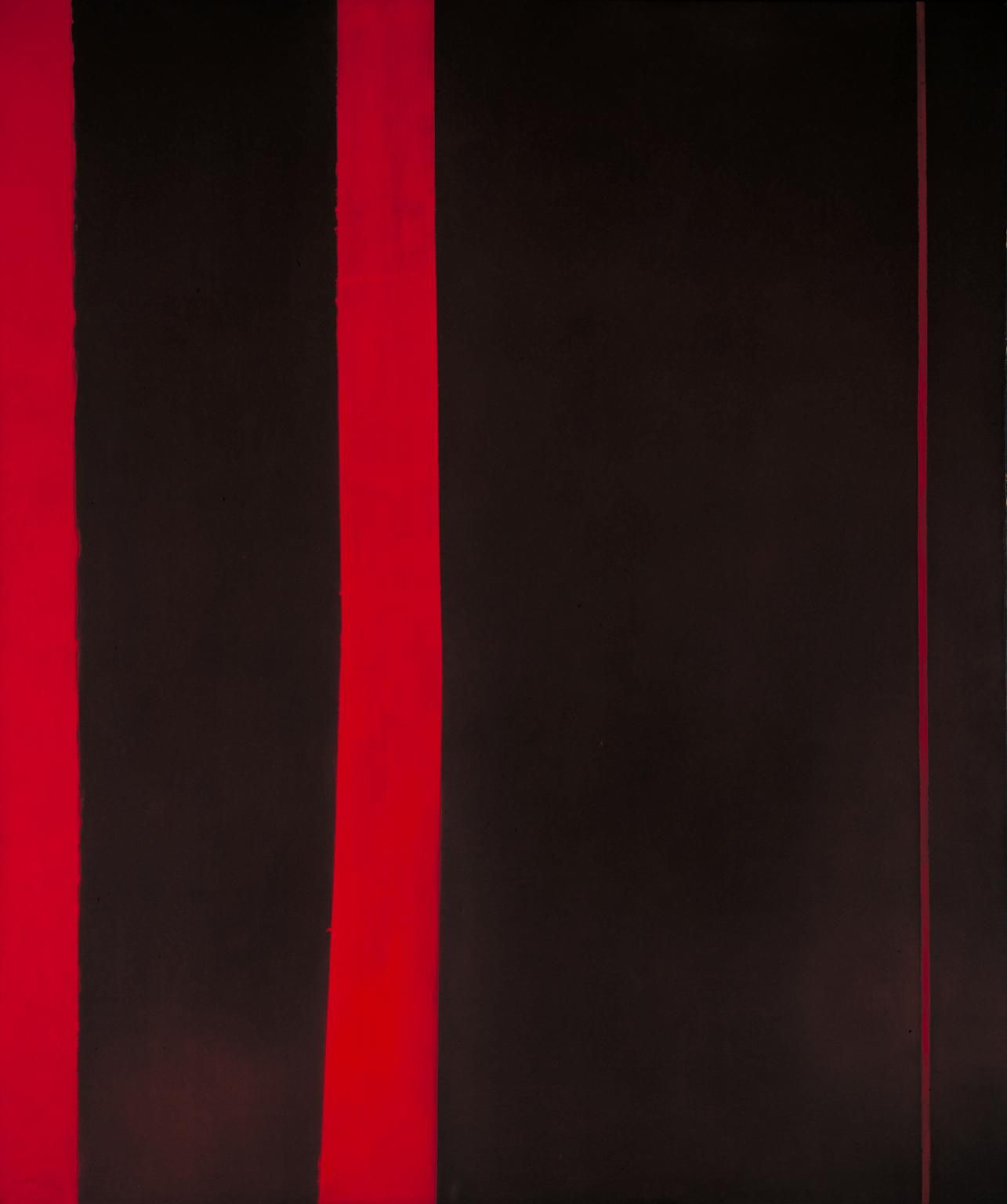
Barnett Newman, Adam, 1951.
PART 2
There is a difference between a purist art and an art form used purely. In the former, the result is a formal pattern which, separated from the emotional excitement that accompanies insight or revelation, is objective, cold, impersonal, and consequently incapable of giving complete satisfaction to the intensity generated by man’s spiritual need. The best that can be said for this type of art is that it is decorative, that it satisfies man’s taste for “beauty”.
There has been a great to-do lately over Mondrian’s genius. His point of view, his fanatic purism, is the matrix of the abstract aesthetic. His concept, however, is founded on bad philosophy and on faulty logic. Mondrian claims that should we reduce the world to its basic shape, we would see that it is made up of horizontal and vertical lines, the horizontal table-line of the earth, the vertical lines of the things that stand and grow on it. Were this oversimplification true, what logical process is it that asserts that since the world is made up of horizontal and vertical lines, therefore a picture made up of such line sis the world or a true picture of it ?
The insistence of the abstract artists that subject matter b eliminated, that art be made pure, has served to create a result similar to that in Mohammedan art, which insisted on eliminating anthropomorphic shapes. Both fanaticisms, which strive toward an abstract purity, force the art to become a mere arabesque.
On the other hand, the point of view maintained by the new painter, that an art form must be used purely, has the virtue of making it a tool for the refined expression of concepts that cannot be handled by lesser methods, to the end, paradoxically, that is able to express the most abstract thought. Just as mathematics, which is abstract, has limited beauty in its nature when used to express an important concept so that we see its convolutions, just as mathematics is a language that gives shape to thought, so the new painter feels that abstract art is not something to love for itself, but is a language to be used to project important visual ideas. In this way, abstract art can become personal, charged with emotion and capable of giving shape to the highest human insights, instead of creating plastic objects, objective shapes which can be contemplated only for themselves because they exist between narrow limits of extension.
The new painter feels that these shapes must contain the plasmic entity that will carry his thought, the nucleus that will give life to the abstract, even abstruse ideas he is projecting. I therefore wish to call the new painting “plasmic”, because the plastic elements of the art have been converted into mental plasma. The effect of these new pictures is that the shapes and colors act as symbols to sympathetic participation on the part of the beholder in the artist’s vision. Since the artist’s ideas are personal, since they do not revolve within any organized social pattern as do the religious symbols of a well-integrated religious society, they cannot be conventional symbols or ready symbols or even realistic symbols. The artist must of necessity use abstract symbols, symbols that he creates out of the pure language that is painting today. Their plasmic nature consists in the fact that when a personal symbol is integrated with the abstract idea, it has the living elements within it that will carry the living thought, as against conventional abstract painting, which reduces the symbolistic idea into nonrealistic shapes. The world cannot be embodied in the mathematical symbols of x and y, but x and y can be used to give us a greater understanding, a vision of the world. The new painter owes the abstract artist a debt for giving him his language, but the new painting is concerned with a new type of abstract thought.
PART 5
What is the difference between plastic and plasmic shapes? The common denominator of modern painting has been a technical concern with the elements of the medium. The impressionists studied color; the postimpressionists, shape; the cubists, the picture plane; the abstractionists and surrealists, subject matter. The approach to painting, therefore, has been dominated by an objective, almost scientific attitude. The new painting has arrived at a point where the technical problems of the language have been pretty well solved. The new painter is taking his language for granted. He accepts and has absorbed the plastic devices of art and has developed what perhaps is the most acute level of sensitivity to the grammar of art ever held by any painter in history. We have in our time the largest community of men of taste ever seen in history, men who know good color, good design, good shape, with an ease that comes from a thorough, scientific attitude. The new painter is, however, dissatisfied with this objective attitude toward his art. To him it is no longer a problem of creating powerful forms, rich color, exciting atmosphere – what is generally known as “quality”. He feels that the crucial problem of the painter today is what to do with this quality, what to express. Even more fundamental is the need to be expressive per se. He feels the he is on the threshold of a new time, when the plastic or decorative aspects of his art must be transcended so that the painter can project some concept. The new painting is therefore an expressive art, yet not of the painter’s personal feelings, so well explored by the expressionists. The truth is not a matter of personal indulgence, a display of emotional experience. The truth is a search for the hidden meanings of life. To practice it, art must become a metaphysical exercise. That is why the new painter is dissatisfied only to titillate our sensibilities. That is why he has no intention of giving us cut-and-dried journalistic answers. The new painter is in the position of the primitive artist, who since he was always face-to-face with the mystery of life, was always more concerned with presenting his wonder, his terror before it or the majesty of its forces, rather than with plastic qualities of surface, texture, etc. The primitive artist practiced a nonvoluptuous art and concerned himself with the expression of his concepts. The new painter, similarly, is anxious to act as a medium for the muse to link the beholder with essences.
– Barnett Newman, The Plasmic Image, 1945.
 SUPPORTLESS PAINTING
[…] par champs colorés, et plus spécifiquement sur Barnett Newman, qui, dans un article intitulé L’image plasmique, parlait beaucoup des qualités plasmiques et des qualités plastiques de la peinture. Dans le […]
J’aimeJ’aime